Showing posts with label NDP. Show all posts

Sunday, March 2, 2014

Canada Moving Toward US Style Partisan Administered Elections

I am by no means well read on the nitty gritty of Canadian federal elections, but this strikes me as an incredibly bad idea:
[Former B.C. Chief Electoral Officer Harry Neufeld] says Section 44 of the government’s new legislation would allow all central polling supervisors to be appointed by a riding's incumbent candidate or the candidate's party.
"It’s completely inappropriate in a democracy, " said Neufeld.

Under current legislation, central poll supervisors are appointed by returning officers, who are hired by Elections Canada. The supervisors are put in place at polling stations to make sure voting unfolds smoothly.

What could possiblay go wrong with such a well conceived scheme?  The government's answer? 
But a spokeswoman for the minister of state for democratic reform says the Elections Act already allows for candidates and parties to appoint other polling station officers.

"This is the case for revising agents in s.33, deputy returning officers in s.34, poll clerks in s.35 and registration officers in s.39 of the existing Canada Elections Act," said Gabrielle Renaud-Mattey.

Renaud-Mattey also points out that the idea was recommended by the Commons procedure and House affairs committee and that the returning officer can refuse to appoint the central polling supervisor recommended by the candidate or party.
Nowhere in here do we see an actual reason for doing this.  That other elections officers might be picked in a similar manner doesn't tell us whether this is a good idea.  The CPS is the chief official at each polling facility, overseeing however many deputy returning officers (who run each individual "poll") there are, as well as more general issues to that site.  Whatever the merits of letting the incumbent party pick the DROs, having the whole operation overseen by a non-partisan appointee who reports to Elections Canada (and owes nothing to the local incumbent party) is self-evidently wise.

That a commons committee dominated by Conservative MPs recommended this is similarly unpersuasive.

The bizarre thing is that the appointment power of Central Poll Supervisors was not among the issues raised by anyone to the government or the Commons' committee on Procedure & House Affairs.  It is a solution in search of a problem.  Even if you delve into the actual Committee report on matter, it really appears like Elections Canada asked to solve a different problem (not enough Elections officers supervising) and the Committee just interjected "Great, how about we also let the parties pick these people?"  Section I.3:
The Chief Electoral Officer proposes to amend the Act to authorize returning officers to hire additional election officers in situations where the Act does not grant this power. In the last general election, the CEO used his power of adaptation of the Act to enable returning officers to hire additional election officers including poll clerks, registration officers, information officers and central poll supervisors. These additional election officers were required mainly for advance polling stations. The authority to hire additional election officials has been necessitated in recent years by the increasing voter turnout at advance polling stations.

[...]

The Committee, however, raised a related issue in the course of its consideration of this recommendation: permitting candidates or electoral district associations to nominate those individuals who may be selected by returning officers to perform the functions of central poll supervisors, given the important role played by these officials.
Wait, what?  What is the argle bargle reasoning here?  It's almost completely non-sequitur to the issue Elections Canada raised (the need for more officials), and the logic is baffling: "given the important role played by these officials."  Yes, the role is important, why does that make partisan control a good idea?

The whole raison d'etre of having a thing like Elections Canada is to ensure the government of the day cannot easily manipulate election outcomes. Everything that moves away from that goal must be viewed with extreme skepticism. This isn't quite Katherine Harris giving the 2000 election to George Bush, but it's a couple steps in that direction.

It is true the Returns Officers (still picked by Elections Canada) can reject particular nominees under the proposed changes, but that puts the onus on Elections Canada to find reason to reject specific individuals.  The practical reality is this won't happen very often, as most partisan shenanigans will tend to fly under the radar, and is entirely reactive to people who have behaved in sufficiently egregiously partisan ways while acting in election oversight capacities. 

Even relatively honest people so appointed are now aware their role as CPS is a result of the incumbent party picking them, so their loyalty goes that way, rather than to Elections Canada.  If they want to be picked again (or have other ambitions in that party) they will need to do a "good" job by the party's reckoning.  I realize nearly everyone working on elections has personal opinions and many may be loyal party members, but that is still materially different from getting your election job as a result of partisan loyalty.  It's safe to assume the people picked will not be picked because of their ability to run a clean election as the top criteria.

In what I am sure is an unrelated matter, the Committee supports increasing the pay rates for Elections workers & officers. 

What's doubly alarming is that neither the NDP or Liberals, who have representation on this committee dissented over this point.  The NDP's report only disputes 3 unrelated issues, and the Liberals didn't seem to even issue a dissent.

I hope I am missing some great countervailing control that makes partisan manipulation of election conduct still a very difficult and risky proposition but I'm not seeing any merits in this. At the very least it just creates a system of partisan patronage, even if the people picked do their jobs with reasonable honesty, the prospect for graft is real. 

I doubt most Canadians will know that when they go to vote in 2015, all the leading officials at their polling place are partisan picks.  It certainly changes how I view the process of voting, and undermines confidence in the system.

Monday, April 29, 2013

Not Impressed with NDP Climate Motion Ploy

Today the NDP's environment critic used an opposition day to have the House of Commons vote on this motion:
“That this House: (a) agree with many Canadians and the International Energy Agency that there is grave concern with the impacts of a 2 degree rise in global average temperatures; (b) condemn the lack of effective action by successive federal governments since 1998 to address emissions and meet our Kyoto commitments; and (c) call on the government to immediately table its federal climate change adaptation plan.”
Unsurprisingly, the Conservatives, Liberals and sole Green Party MP Elizabeth May all voted against this motion.  Obviously the NDP didn't think for a second the Liberals were going to vote for a motion that condemns their own governments between 1998 and 2006 and Elizabeth May has objected on the obvious grounds that the motion only calls on the government to table an "adaptation plan" rather than an action plan to reduce greenhouse gas emissions.

The NDP are quick out of the gate with items like this, grouping the Liberals and Conservatives together as is their wont.  I'm not impressed with the whole thing, it's beneath the NDP for one thing and speaking as a voter who could be persuaded to vote NDP instead of Liberal, this does nothing to inform me about actual, meaningful policy differences between the two parties on an issue I care deeply about, climate change.

I am all for the NDP finding ways to inform Canadians about important distinctions between themselves and the other left-of-centre parties so that when 2015 comes around they can fight for the largest share of that ~65% of the public that won't vote Conservative, but this doesn't seem helpful to that end.  It doesn't tell me any actual salient difference between the Greens, NDP and Liberals on the climate issue.    That both other parties have such obvious outs to vote against this motion makes it ineffective as a tool to prove that the NDP line on either the Greens or Liberals is accurate (the usual line being that both are effectively conservative parties and not true progressive institutions).

Lest I be accused of concern trolling, I'll say I really would like to know if Justin Trudeau would take meaningful action on the climate if elected in 2015.  I fear he won't, and would like it if the NDP finds ways to force him to take significant policy stands that allay or confirm that fear.  Asking him to have his party condemn the Chretien and Martin governments (much as they deserve condemnation on this file) isn't going to do that.  Ethics of the thing aside, if Trudeau had somehow had his party support this motion, the news coverage would be all about the meta-story of the Liberals voting to condemn their own past governments, not about the climate issue.

Maybe I'm not the target audience and this will be very effective at, well, tricking, less politically aware voters who have the environment as a top-of-mind issue and don't read past the headlines.  But it doesn't work on me, and strikes me as the stereotypical form of holier-than-thou progressivism that the NDP is often criticized for.   It's not the biggest deal in the world, just some petty political positioning and attack-ad fodder, but even describing it that way is to repeat that the NDP should be better than this.

Wednesday, June 6, 2012

More Sun News Blatant Bias

Researching the piece yesterday on Sun News Network's evident complicity in knowingly airing a false and misleading story to Canadians, I came across this, by QMI's Mark Dunn, carried by Sun News:
OTTAWA -- Finance Minister Jim Flaherty opened the door Monday to new stimulus spending to help the economy weather what many economists fear is a looming global recession.
Ok, as far as it goes.  In fact, I'd call this mild good news, Flaherty is surprisingly Keynesian and willing to eschew conservative economic nonsense in understanding that some kind of European economic collapse might necessitate further stimulus.  Go down a few paragraphs:
The official Opposition NDP did not mention the worsening economic picture during question period Monday, nor has it raised the potential loss of union jobs in Oshawa. It was more concerned with smoke stack monitoring and a budget implementation bill it opposes.
Wait, what?  This is an ostensible news piece, and by what evidence do we conclude that the NDP is "more concerned with smoke stack monitoring" than job losses or economic conditions?  Based on their questions on one day's QP?  Even the bit noting the NDP "did not mention" the economy or job losses in Oshawa is of course highly dubious.  Is it normal journalistic practice to list arbitary things that politicians or political parties don't discuss on some particular day's QP?  I bet the NDP also didn't mention that they disapprove of child pornography and slavery.  Better get on that scoop, Sun.

It should go without saying that the NDP has made a stink over the job losses in Oshawa and the poor economic conditions. Just not today.  If Sun News wants to run some kind of statistical analysis of topics the NDP raise in a long series of Question Periods, and make hay of that, that at least might indicate some legitimate preference of certain topics to others on the part of the NDP. 

But wait, there's more:
In its most recent budget, the government announced controversial changes to old age security, employment insurance and other measures to sustain the economy in the long run and prevent the kind of budget problems many European countries are experiencing.
Behold the perils of the passive voice.  Is the author stating that the controversial measures actually do sustain the economy and prevent European budget problems?  Or just noting that the government claims they do?  Hard to say, but that's where honest journalism would require a more explicit note that these are the government's claimed justifications for these things, but really this is stated as if it is fact (it's not even close to true that European debt crises are generally about pensions and employment insurance anyway, mostly it's completely about their collapsing economies not supporting sufficient tax revenue.  Spain was running government budget surpluses prior to the crisis)

It also makes a part of the paragraph above quite ridiculous, where he describes the NDP as opposing "a" budget implementation bill.  There's only one.  It's "the" budget implementation bill, and the NDP's opposition is about the controversial matters like changes to OAS he is describing in such factually glowing terms.  It's not some strange arcane matter that has journalists scratching their heads, it is in fact the sort of thing the opposition is supposed to focus on, and frankly, to oppose.

I often challenge conservatives complaining about CBC's supposed liberal bias to provide examples and they never do.  They usually get sputtering mad or feign amusement over the notion that anyone challenges such an "obvious" truth.  Well, here's a pretty good example of the reverse.  I found it just reading Sun News' front page, picking an article I found interesting for its own sake.  If that's par for the course there, I may have to revise my view of them as a pale shadow of Fox.  They seem right in the running in the competition for most egregious bias.

Wednesday, May 2, 2012

It's Time to Update the Ontario Condominium Act

Don't know what chances it has, but I'm for this, from Trinity-Spadina Ontario NDP MPP Rosario Marchese:
Dear Friends,

Did you know the law that governs your condo hasn’t been changed in 14 years?

On May 10, I will be introducing legislation to improve Ontario’s Condominium Act.  If my bill is passed, Ontario’s laws will finally reflect the interests of condo owners. My proposals include the following:  
  • The creation of a Condo Review Board to settle disputes between condo owners, boards, property managers and developers. (Currently, disputes must be settled through the courts at great financial cost.)
  • Establishes better building and soundproofing standards.
  • Prevents developers from asking owners to move into unfinished buildings.
  • Extends developer responsibility for condo fees from one to three years.  
  • Improves Tarion warranty protections on new condos and provides warranty coverage for conversion condos such as lofts.
  • Requires developers to use good faith language in contracts and to disclose any business names they have used in the past.
  • Requires property managers to be licensed by the Province.
I will be speaking at information sessions about my condo bill on the following dates:

CityPlace Residents’ Association Town Hall Meeting
Date: Sunday, May 6.
Time: 3-5 PM.
Location: Renaissance Hotel (next to the Rogers Centre).
Map:

King West Community Meeting
Date: Wednesday, May 9.
Time: 7-9 PM.
Location: Thomson Hotel, Wellington Room (550 Wellington Street West, south of King and Bathurst).
My wife and I both bought new condos off plans in the early 2000s before we met.  Mine went okay as far as these things go, but hers was a debacle with a developer who clearly was not playing in good faith, and took advantage of every loophole and a few that aren't even loopholes but that they know they can get away with.  Almost every item on that list would have been a tremendous help to her, and Tarion proved to be toothless or captured by the developers based on how it handled her complaints.  There was a litany of ridiculous things the developer did, but the most egregious was how they rushed to get the occupancy permit, then cancelled it at the last minute (after she had already booked movers) and even when she did get legal occupancy, she only had power to one item in the whole unit, a light by the entrance, clearly done to fool the inspector that the unit had power (no stove, fridge, lights anywhere else, etc).  That had to be illegal.

As a first time homebuyer you really only have the option to sue over stuff like this, and the reality is that isn't likely to happen over a collection of small stuff, your instinct is always to just get through it.

I know this is mostly an upper-middle class problem and all, but still no reason to let these scumbag fly-by-night developers bilk people.  This is all part of the decline of the middle class as you get fleeced at every opportunity and the law is always on the side of the powerful.  The bit about forcing disclosure of other names the developer has operated under is a pretty good idea.  Some of the bigger developers with established reputations to protect are generally pretty good for that reason, but currently that's really the only worthwhile consumer protection there is when it comes to new condo purchases, and you definitely pay a premium for the big name builders.  Even that is no surety, as established brands have been known to decide to cash in on their residual good will at times and churn out some junk for a quick profit.

There's no social advantage I can see to letting shoddy developers put up crap buildings that their owners hate and take a loss selling off.  Condo buildings are going to be there for decades, they should be built well and if a few shoddy developers stop doing business, in an overheated real estate market I can't see how that's a negative.  Ontario has a minority government right now so it's a chance for the age-old formula of the NDP pulling the Liberals left to work again.  My wife and I are unlikely to ever buy a new condo again, but no reason anyone else should go through what she did.

I wrote the Premier and Margarett Best, the Minister of Consumer Services.  Private Members bills rarely make it to law, but this is a good idea and I hope this one does.


Wednesday, May 4, 2011

Layton's Challenge

Following up on my thoughts on the hidden limits that majority governments face, it's worth thinking about what Jack Layton has to do to be an effective Opposition leader.  The biggest challenge will be the perception of his caucus as inexperienced, which could easily become a narrative that Layton's team is not ready to govern, which even if Harper's lot stumbles could prove fatal to any hopes of an NDP government.

The biggest key will be his selections for front bench (or "shadow cabinet" as sometimes called).  These are the MPs who generally ask the bulk of the questions during Question Period.  They're the ones who, if they can land hits will be covered by the media and if they get outwitted, will make Harper's group look good.

Layton is fortunate to have a decent set of experienced MPs who are good at jousting in Parliament.  This includes Layton himself, who as Opposition leader decides the order of Opposition questions and usually leads off the questions on the biggest issue of the day.  So Layton will have plenty of limelight.  But he will need to share some limelight in order to build the perception that he has a strong team, ready to take charge if Canadians decide they want a change in four years.

In a very real sense, this is a very similar task as the Prime Minister picking his cabinet.  Layton will have to try and ensure adequate representation from all regions, as well as diversity of backgrounds of the individuals chosen.  One real challenge in this area will be that the majority of Layton's caucus comes from Quebec, and yet are overwhelmingly rookies.  How many front bench slots does he give to untried fresh faces?  How many of his existing Shadow Cabinet does he demote to the back benches?  He's pretty much maxed out in Quebec, so his job next election is to win more seats in English Canada.  He will have to balance the expectations of Quebec voters who have taken a chance electing his party, and the need to appeal to other regions in order to grow a winning coalition.

Given that his caucus will be the overwhelming majority of the Opposition itself, the NDP will get the bulk of the questions and that's one nice thing about knocking the BQ down below official party status, he really only has to share significant time with the Liberals (though independent MPs do get to ask questions sometimes, and one of the independents is actually Green Party leader Elizabeth May, how Layton handles her will be interesting to watch).

My own non-expert thought is that Layton might be wise to pick his best veterans for the key slots (finance, foreign affairs, defence) and assign a solid number of slots to the Quebec newcomers, but curtail their Question time until he has a better handle on their abilities.  He's going to have to make changes often in the early going here to seperate wheat from chaff and not allow a "not ready for prime time" meme to gain steam.  First impressions will be important, so he has to ensure the first week or so of QP goes smoothly before giving any of the more unknown elements a chance at the limelight. 

Building his party from a distant fourth to Official Opposition was a real test of Layton's political and campaigning acumen.  This is a different sort of test.  Before Layton had a small, manageable team.  The NDP federally has no institutional memory of managing 100+ MPs.  It's a real management challenge and a different ballgame.  Certainly Harper had a rough go of it, with a number of prominent bad cabinet picks.  Luckily the spotlight is generally on the Government.  If the competence of the Opposition becomes the issue, that's already a really bad sign.  As long as Layton can identify and minimize any weak MPs, and have his veterans manage to keep the media looking at the Government, he should be able to settle in and spend the next four years building the narratives he'll need come the next campaign.  The people of Canada will not be better off in 2015, and they should blame Stephen Harper while seeing Jack Layton as the guy and the NDP as the party to fix his mistakes. That's what he has to sell now and he has four years to do it.

Saturday, April 30, 2011

NDP for Canada

For what it's worth, while opponents of the Harper government should still vote tactically in ridings where the NDP are a distant third and show no sign of being able to win, Jack Layton and the NDP must now be the default selection for your vote. 

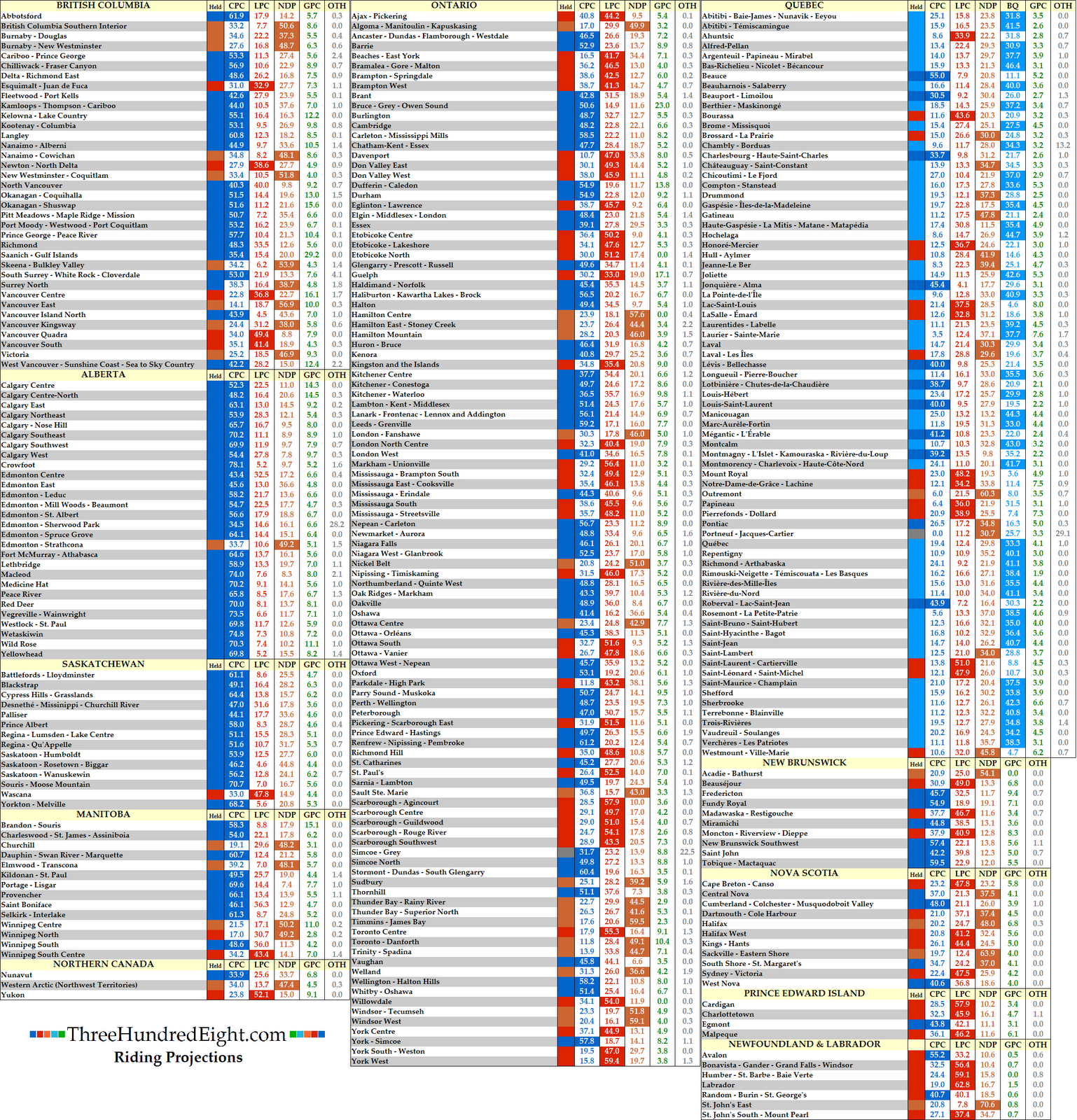
I have not been shy in my fears that Layton's rise could lead to awkward left vote splitting, particularly in a substantial number of seats in Ontario that puts Harper over the top to a majority, but now the NDP has been in the polling lead over the Liberals and Bloc across nearly every region (Three Hundred Eight still shows the Liberals narrowly leading in the Atlantic and Ontario, but the trend in Ontario is clearly in the NDP's favour).   What finally starts to reassure me is that the NDP have been projected to win a small number of currently held Conservative seats, and projected to hold a couple that the Conservatives were earlier projected to win.

Voters in Ontario should be most sensitive to the need to vote tactically Liberal, particularly in the 905 belt, plus a few other ridings like York Centre, Kingston and the Islands, London, Guelph and a number of others where the NDP are not very likely to close the gap in time.  Sorry NDP, the memory of Premier Bob Rae is still hurting you in the province, fairly or not. I'm not sure why the NDP don't have more traction in the Atlantic, so again tactical voting may apply.

Michael Ignatieff has run on a more liberal platform than I would have expected from him, and in the traditional way campaigns are run and assessed, I think he has done a fair job.  His debate performance wasn't terrible, no major gaffes, takes media questions well and he stick handled a few Liberal candidate problems well enough that they didn't become major issues.  His personal approval ratings have gone up through the campaign.  But he started from such a disadvantage for avoidable reasons such as that he should never have become leader of the Liberal party after the majority of the party's base united behind a dark horse candidate (Dion) to keep him out of that job in 2006.  I was one of them.  When Ignatieff became leader under strained circumstances in 2009, it's true there wasn't a party revolt, but almost no one was thrilled.  Ignatieff started out without the home team cheering section a party leader needs to build a positive image with the population.  Harper and Layton both have this. When Harper's inevitable attack ads came screetching in, Ignatieff did not have people to stick up for him in coffee shops and by office water coolers.  

Further, much like Hillary Clinton, Ignatieff cannot escape the serious baggage that is his support for the invasion of Iraq while still in America.  Both Paul Martin and Stephane Dion were able to make up some ground in 2004, 2006 and 2008 by pointing out Harper's support for that war, while reminding voters it was a Liberal government that kept Canada out of it, and in fact even denied George W. Bush Canada's moral support for the endeavour.  It should be remembered as a particularly high point in the Liberal party's history. Ignatieff cannot use this.  Meanwhile, Layton and Duceppe can and have used it against him.  I'm not opposed to Ignatieff as Liberal leader because he's an intellectual, I'm opposed to him because he's a crappy intellectual who gets important things very wrong.  Additionally between Ignatieff and Rae they have denied the Liberals any distinction with the conservatives over Afghanistan and again it is no surprise that the Liberals are bleeding support in a country that is tired of this war.  Quebec particularly so and look where the NDP wave started.

Finally there is Jack Layton himself.  I have my qualms about him.  I never warmed to his personna the way others seem to have, but that alone cannot really be decisive.  Layton strikes me a bit like a used car salesman.  That perception may be unfair, but it is what it is.  That said, I did enjoy Ian Welsh's story about Layton and am willing to revise my views on Layton as events dictate.   I don't think he is above cynically exploiting issues for partisan advantage, and I worry that he wants to beat the Liberals much more than he wants to beat the Conservatives.  Maybe that's how it has to be for a smaller party hoping to overtake a traditional big-tent party's place.  It doesn't happen very often so there aren't a lot of models to compare against.  For NDP supporters I hope they can keep a small part of their brains aware that Layton is a politician and a human and he is not immune to the failings of those classes. Layton can and has put the Party's interests over the interests of Canada.  He does it less often than the Liberals, but it does happen.  I worry about Layton's ability to hold to the NDP's progressive core while trying to navigate a massively enlarged coalition.  He has not persuaded me that his promises to Quebec come from sincere progressive convictions about how Canada should accomodate our two solitudes, so I sense opportunism.  I am giving Layton a chance to prove my fears wrong.  Nothing in his record is as odious as Ignatieff's writings on torture or in support of a pointless, illegal and unjustified war against Iraq.  Certainly he will be a better Prime Minister than Harper because he doesn't believe in all the bad ideas Harper does.  Conservatism doesn't work, and remains a destructive force of inequity, dishonesty and division upon the modern world.  The differences between Layton and Ignatieff are important, but next to Harper both are vastly preferable for the simple reason that they are at least open to doing the right things for Canada.

At the start of this election, my read was that the best that could come out of it would be another Tory minority which led to changes of leadership potentially in all four parties.  Now at least Layton's rise has given me something more to hope for.  We might actually be able to get Harper out of 24 Sussex and the NDP might get a chance to show Canadians how well progressive government can work for them, and for Canada.  There's a lot of obstacles still even if Layton does become Official Opposition leader, but something has finally changed from our 5 years of political stalemate.  The overwhelming need is to remove Richard Nixon North from office and I'm prepared to support the best available option to do so.  The NDP are now that best option for most places in the country and deserve a chance to prove the skeptics wrong.


Friday, April 29, 2011

Will the NDP boom increase the chances of electoral reform?

It really should, no matter the outcome, two scenarios:
  1. My fears are realized, the NDP increase splits enough previously Liberal seats to give Harper a majority.  Certainly Harper would have no interest in pursuing electoral reform, but the prospect of millions of Canadians giving the NDP a chance and seeing it a Conservative majority government as the result would create a lot of anger and lead to a groundswell for voting system reform.
  2. The NDP win enough seats to deny Harper a majority.  Whether they end up as official opposition, remain behind the Liberals in seat count or actually win government in their own right, having a lot more NDP MPs in a minority parliament, with a very likely NDP/Liberal coalition government forming would present the NDP a historic chance to reform the electoral system, as they have long supported proportional representation.
The second scenario has some quite contemporary precedent, in that it is precisely one of the concessions that the Liberal-Democrats got from the UK Conservatives in agreeing to form a coalition government with them.  Unfortunately, polling shows like so many electoral system reform referenda, the proposed alternative voting (AV) system is likely going to fail.  Click through to that Crooked Timber piece for a great discussion in the comments on the merits and drawbacks of various alternatives to First Past The Post (FPTP).  This is a topic progressive activists should refresh on since I don't think the road to PR (the usual preferred system of the left) is going to be very easy, and we should all consider what alternatives would be better than the status quo and have a better chance of success than PR. 

Also given the defeats of voting system referenda in BC, Ontario and now probably the UK, it would be well to study the politics of those to avoid the same mistakes.

Wednesday, April 27, 2011

Prediction is Difficult, Especially About the Future

With apologies to Niels Bohr, I just wanted to take a moment and point out that the art or science of predicting Canadian election outcomes is actually far less advanced and accurate than American readers might be used to.  I have written of my fear that the NDP boom could lead to the obscene outcome of a Conservative majority on a scant 37-38% of the national popular vote, but I could easily be quite wrong, and I really hope I am.

Partly that is because the situation is still developing and if the NDP "orange crush" continues to grow until election day itself, then it will quite likely go past the second tipping point I discussed, where the NDP actually wins significant numbers of currently Liberal, BQ and (most importantly) Conservative seats where they up until now are not believed to lead, rather than just splitting the non-conservative vote and letting the Conservatives win a number of normally Liberal or BQ ridings without increasing their actual support.

The problem for the NDP is that they started so far behind the Liberals and Conservatives that even a historic 5-10% increase in national support doesn't necessarily make them competitive in nearly enough ridings to guarantee a Tory minority.  I don't rule out the possibility of a super-duper history changing increase in support of 15% or more that actually puts the NDP into real competition with the Conservatives to form the government.  After all, this actually happened in Ontario in 1990, which shocked the nation (and the NDP) by delivering an NDP majority government to Canada's most populous province.

But putting aside the dynamic nature of the situation very much still in motion, just in general Canadian elections are harder to predict so you should discount significantly anyone's predictions (including mine):
  • 308 elections versus 51.  First up, predicting the outcome of a US presidential election is easier because there are a lot less constituent parts that decide the outcome. 
  • Less polling.  There's plenty of national and regional polls, but these are really of rather limited value in predicting the individual riding outcomes which actually determine the real outcome.   We're a smaller country, a smaller media market, there's just a lot less overall money flowing in the system to pay for the level of polling we see in the US, and polling a state is just much easier for pollsters than any 1 riding (hard to find 1000 adults willing to pick up the phone living within a much smaller geography).
  • More competitive races.  The US Presidential is 51 seperate elections, but really only a relative handful of these are truly competitive.  I haven't crunched the numbers in any meaningful way, but Canada's riding boundaries are not really gerrymandered.  The term doesn't even get used up here.  There are certainly safe seats for each party, but compared to the US congress, a far higher proportion of MPs in Parliament actually have to compete for re-election.  Aside from the lack of gerrymandering, the stronger party system here means that things like the incumbentcy factor and name recognition matter much less.  If your party is out of favour, you're in trouble.  In 1993, the ruling Progressive Conservatives lost all but 2 seats.  
  • More competitive parties.   Even at their peak in 2000 under Nader, the US Greens were not even a threat to win a state or take a seat in Congress.  Sure there was Perot but in general, it's almost always a 2 candidate race.  Canada has five parties that could win seats in Parliament.  Plus a couple independents.  There are a significant number of competitive 3 way races for ridings, particularly in BC and Quebec, and even a four-way race or two.   It's just damn difficult to predict the winner in these ridings and even if you are lucky enough to get a riding poll, it's hard to predict how events will affect the support as the poll ages.  
  • First past the post.  Americans have the same system, but it's worth calling this out to avoid confusion say with proportional representation based European multi-party systems, where a 5% increase in support for some smaller party means they get 5% more seats. 
As an empirical sign of all this, one of the election prognostication sites, electionprediction.org still has 60 seats listed as "too close."  Their track record in the past 3 Federal elections (2008, 2006, 2004) has been a respectable near-90% right call average, and less than a week from this one they don't want to call 20% of the seats.  Harper only needs to gain 12 for a majority, and they have 5 times that many as toss-ups.  So yeah, I'm worried.

Still, I can't fault the NDP die hards for their enthusiasm.  I know they've been hoping for (and, ahem, repeatedly predicting) a break through like this for a very long time.   My negativity is just my read on the likely outcome, not some cynical attempt to deflate them.  I was against Ignatieff becoming Liberal leader and now he might well preside over the death of the Liberal party as the governing alternative or maybe even as a party at all.  Given the choice between another Harper term and some kind of Layton/Ignatieff coalition I will of course hope that Layton can complete this budding miracle.   Eric at 308 is skeptical that the NDP can go from fourth to government and offers some solid reasoning why, and I find that more intellectually persuasive than anything I am hearing from the hopeful Orange crowd.  But there is a very real chance we're just off the map as far as empirical based models go, and into a realm where polling and past experience offer very little predictive value.

That said, I'm very glad for our non-partisan and rock solid voting system.  Because the realm of possible outcomes is quite wide so it's nice to know in advance I can have strong confidence that whatever result we get is real.  If it is Jack, I will eat my orange crow with some gusto.

Friday, April 22, 2011

Some numbers around the cost of an NDP boom

To put a bit more substance on the post below, I analyzed the riding-level numbers that Three Hundred and Eight calculates using his model.  Under the scenario of 5% of voters leaving the Liberals for the NDP, applied uniformly accross all 308 ridings here's what I found:

The Liberals lose 18 seats they're currently projected to win (10 go CPC, 4 go NDP, 4 go BQ)
The NDP hold 2 seats the Conservatives are currently projected to win
The NDP takes 1 seat the BQ is projected to win

Net result:
CPC +8
LPC -18
NDP +7
BQ +3

And the new seat totals would be:
CPC 158
LPC 58
NDP 43
BQ 48
Ind 2

I realize this is a very unrealistic scenario in that many voters are aware in their riding whether the NDP is competitive and probably would still vote strategically for the Liberal even if they decide they prefer the NDP, but the point was more to illustrate my claim about there being multiple tipping points.  A 5 point gain for the NDP at cost to the Liberals would result in a safe Conservative majority, the Liberals would still be official opposition and the NDP would still be the fourth party, only managing to tie Ed Broadbent's historical top result (which was done in a smaller parliament).

In that result, could the NDP hold on to those voters?  Many of them would regard this as simply a disaster and it would be hard to predict how loyal they would remain.

I think it is all or nothing in this game.  The NDP have to overtake the Liberals and become the official opposition in order to solidify their gains.  I don't know how they do that given that there are relatively few ridings outside the ones they're already winning where they are in second or a close enough third to actually win, absent a real tidal wave/landslide shift in support (like 10% instead of 5%).

Real Danger in the NDP rise of a Tory majority

Three Hundred and Eight has the Liberals down 4 seats, the NDP up 1, and the Conservatives up 3 from his last projection, and says:
There are 15 seats in the projection where the NDP is within 10 points of the leader. Two of those seats are held by the Bloc Québécois, five by the Liberals, and eight by the Conservatives. So the NDP could be a bit of an equal opportunity spoiler. But in a lot of close Conservative-Liberal seats, the NDP's increase in support could turn more than a few ridings over to Stephen Harper.
 This is the very real danger Liberals traditionally warn about in voters turning to the NDP.  This is often written off as partisan "fear mongering" which tends to imply an irrational or overblown fear being exploited, and maybe in other times and places that has been the case, but given that the Tories go into this election sitting at 143 seats, just 12 shy of a parliamentary majority of 155, and that Canada has a first past the post system, it is a very real threat.

Before I'm accused of making the usual sort of "hold your nose and vote Liberal anyway" type argument, that really isn't my intent.  For one thing I don't exactly have a mass audience, so even if I want to engage in mass voter persuasion it isn't really an option.  No, I'm interested in the potential fall out here.  I should say that of course the situation is very fluid.  This sort of thing could easily, on its own, turn a big pile of soft NDP supporters back to the Liberals if the media starts saying "Tory majority likely..."  But let's assume this happens, what will it mean for the other parties?

The NDP is trying to walk a very difficult tight-rope in order to supplant the Liberals as the alternative party of Canada.  I doubt any of their leaders seriously expect to actually come in first in this election, and maybe they don't even expect to actually come in second.  But beating the Liberals in Quebec and BC would be a huge win for them, setting the stage for the next election to try and do so in Ontario and the Atlantic.

The real challenge will be in keeping these voters, particularly if the additional NDP support does not translate into many more seats, or even a number that seems close to the Liberal number of seats.  The system isn't linear, an extra 5% of the vote doesn't translate into 5% more seats, and there are tipping points - the first tipping point is the one which has the NDP and Liberals split the vote in a lot of Ontario ridings leaving the Conservatives to win the seat with a high 30 or low 40 percent of the popular vote.  If the NDP reach that one, but not the next one, where they win some of those Liberal ridings, we get a Tory majority much bigger than Conservative polling support would suggest, and a potentially huge blow to NDP voter morale.

Will these voters stay with Jack if they decide that supporting him ushered in a Harper majority?

Layton is clearly in it to win it, and committed to this game, so I don't expect anything anyone like me writes about the dangers of this strategy will have any appreciable impact on it, but this is now shaping up to be the most likely outcome.  If you could have told me in 2006 that the NDP were on a 5-10 year plan to replace the Liberals and it would mean some Conservative governments in the interim, but in the end we would have a more progressive alternative governing party I would not have been enthusiastic, but if you could guarantee it would work, I might go along thinking it would be worth it in the long term.

However what if that 10 year strategy doesn't actually work?  What if the NDP reach a historic high level of popular vote support, but the demoralizing result of a Tory majority sees it all fade and the new voters go back where they came from?  Then it will have all been for nothing and no progressive upside.

It's a very real possibility.

Things are about to get ugly, I expect Ignatieff and Duceppe are going to turn some serious fire on Layton now, to try and dampen his personal popularity.  Expect to hear about the Gun Registry free vote, and all the times Layton propped up Harper's government.  Expect to hear about that 2004 letter Layton signed with Harper.  What was Jack thinking progressive Canadians could really get out of a Conservative coalition government that they couldn't wrest from the Martin Liberal minority? 

Meanwhile Harper will chuckle watching his enemies expend precious advertising resources on each other instead of him.

Tuesday, April 19, 2011

Could the NDP and Liberals get along?

Between the post below, and some questions I have about the long term viability of destroying the Liberal party to bring about progressive governance in Canada that I raised over at Merge-Left, I need to post the following table to ensure some of the claims I have made (explicit or implicit) have some backing:


Pollster Ekos does some great "second choice" polling:


First Choice


Second choice Overall 2nd CPC LPC NDP GPC BQ Other
CPC 8.9 - 16.0 13.4 14.4 11.1 9.8
LPC 16.1 17.8 - 40.5 16.5 17.6 6.9
NDP 23.8 21.1 43.2 - 26.8 37.1 11.7
GPC 11.2 11.0 15.9 12.4 - 10.7 12.9
BQ 4.2 2.3 4.1 10.9 3.4 - 12.9
Other 3 2.9 1.6 4.2 3.3 0.0 -
No Second 32.7 45.0 19.1 18.5 35.6 23.6 45.9


If it isn't clear, the way to read this table:  First column is the overall percentage of voters who pick the parties on the left side as their "second" choice.  Then there is a column per party showing what each party's supporters pick as their second choice.  So 16% of current Liberal party supporters say the Conservative party is their second choice, 13.4% of NDP voters say the same and so on.

Here's what I take from this table:

  • Yes, the vast majority of Liberal voters are left-of-centre.  Only 16% would go Conservative, while nearly three times as many would vote NDP.  Almost as many as would vote Conservative would instead go to a minor left-wing party in the Greens.  In a world where the NDP and Liberals were somehow one entity (either because of a merger or because the Liberals collapse) I'm fairly sure most of those 16% saying they'd vote Green could be brought to vote for the combined entity.  
  • More people pick the Greens than Conservatives for second choice.  This is just good news in terms of identifying the real ceiling of the Conservative vote.  In 1984, the Conservatives actually crested 50% of the popular vote, even assuming they won every current voter they have today, plus all the people who pick them as their second choice, they're still below that.
  • Conservatives are least likely to have a second choice.  This is the bad news about the conservative floor.  Almost half their support would not vote for anyone but a right wing party.  
  • The NDP have the best chance of picking up votes from the BQ and Greens.  Given the increasing NDP support in Quebec and less remarkably (but still important) in BC, this is important.  
  • The NDP and Liberals are each other's top second picks.  In fact they're the top 2 numbers on the whole chart. This last is perhaps most important when discussing the possibility of some kind of alliance, merger, coalition, agreement, accord or whatever other poll tested word the leaders call it when and if they come to it.  Throw in the large blocs of Green and BQ voters who would pick the Liberals or NDP second and it's pretty likely a good chunk of them would come over if it meant keeping the Conservatives out of 24 Sussex.
  • The NDP and Liberals are least likely not to have a second choice.  This is related, but still important to note.  Any potential merger of any two parties anywhere will lose some number of die-hard purists who cannot support the merged entity, but NDP and Liberal supporters already appear most open to supporting whatever party will support the goals they believe in.  
I don't know what Layton, Igantieff and Duceppe might have in mind for the post-election scramble, and whether they could pull together somehow to form a government, but if they don't the case for a higher level of formal coordination only gets stronger.  Since compiling this table, Ekos released another poll, whose 2nd choice results (scroll down a few pages) validate nearly everything above (in fact, in the latest poll, more Liberals would choose Green over Conservative).

We can't keep having >60% of Canadians voting for a left-of-centre government election after election and ending up with Richard Nixon North.  Something has to give.

The Canadian Election

Apologies for the dearth of posting, and in particular my dereliction in writing about the situation in Canada since we're in the midst of a federal election.

It's actually shaping up to be potentially a highly consequential election that will likely return a parliament of almost identical composition to the last one.   The link goes to Three Hundred and Eight, a Canadian version of Nate Silver (our House of Commons currently has 308 seats), which currently has the prediction for each party within 4 seats of their totals at dissolution, and with the Conservatives as the plurality winner and by long convention sitting Prime Minister Harper given the first right to form a government.

But beneath that top line results, here are some trends to watch that could mean big long term changes in Canada's politics:

  • NDP gains in Quebec.  Last election the NDP won a single seat in Quebec, which was a fairly big deal as I'm not aware the party had ever won a seat there.  This time their popular support is now competitve with the other non-BQ parties as progressive Quebecois who are at least neutral on sovereignty for the province appear to be leaving the BQ (and possibly the Liberals).  Jack Layton is personally especially popular in the province and that certainly can't hurt though there's reason to think this is about more than him as most NDP leaders tend to be well regarded.  The NDP may have crossed a threshold with Quebecois in convincing them that they are electable, a very important factor in our plurality system.
  • Ignatieff broaches the idea of defeating the Conservative government again.  At least that is my read.  Today in an interview on CBC, Ignatieff (who has categorically ruled out forming a coalition government with the NDP or BQ) discussed the possibility that a returned Conservative minority government would be unable to win the confidence of the House, would fall, and then he (as leader of the Official opposition) would attempt to form a non-coalition government supported by some combination of the remaining parties.   There's lots of wiggle room here, but in principle, Ignatieff is setting the stage for a situation similar to the aborted coalition attempt under his predecessor Stephane Dion at the end of 20078, which collapsed at least partly because Harper successfully demagogued the issue partly on the grounds that the parties in the coalition had not explicitly campaigned on that idea.  Ignatieff is still ruling out a formal coalition, but at least has shown increasing awareness that the Liberals are not likely to vault back into their pre-2006 levels of support needed to form governments under their own right.   
  • Potential for multiple leadership changes.  If Harper doesn't win a majority, the CW here is that his party will get impatient and push him out hoping someone else can get it done.  Ignatieff may be in trouble if he does not substantially improve on Dion's 2008 result.  Jack Layton's health is in some doubt.  Gilles Duceppe has been leader of the BQ for a long time, and there have been complaints about his low key campaign this time around.  Not to forget the Greens, if they don't win a seat, as appears likely, Elizabeth May could also get pushed out.  A Conservative majority is most likely to bring about leadership changes in the other parties, but any of them could go under a renewed minority.
The first two are in my mind potentially good news for progressive/liberal Canadians.   The current spate of Conservative wins is really the result of the way the rest of the vote has been divided, as the support for right wing parties has hovered at 37% in every election since 1997 except 2004, where it dropped to 30% probably because a lot of red Tories were still scared of the newly merged single Conservative party.  By 2006, they had come home and with the Tories sitting at just over 38% in polling, it's really difficult to avoid the question of the best long term arrangement of the non-conservative vote in Canada.  Do the NDP and Liberals merge?  Will the NDP overtake the Liberals as the governing alternative?  Should they along with the BQ re-open the formal coalition subject and try and dampen the public distaste for it?  What of the Greens, can they be brought into either fold or at least a good chunk of their possible 10% support?

Harper is where he is because he was the architect of the merger of two right wing parties.  There was very significant opposition to merging from die-hard Progressive Conservatives who saw the merger as a takeover by the hard-right western Alliance/Reform party (they were largely right).  Some of the old guard Reformers also didn't like it as they feared it would inevitably shift the party toward the centre (which is why they split from the PCs and formed the Reform party to begin with).  Point being, it was not a simple and trivial undertaking, and I think any signs that the Liberals and NDP may find some way to allow the 60%+ supermajority of Canadians to have a government that better represents their views is to be encouraged.

In 2004 and 2006, the Liberals lost a great deal of support, the NDP, BQ and Greens all gained some.  However since none have the critical mass needed to form a government under their own right (putting aside the problems with the BQ in any such arrangement), we're stuck with Conservative governments unless and until they somehow figure a way to get together.  It looked like we were going that way in late 2007 2008, but upon Ignatieff taking over from Dion as Liberal leader, he pulled the Liberals back from any such arrangement.  I presume he did this at the behest of the Liberal old guard, who probably thought that voters would eventually come home to Canada's "natural governing party" if they just put in a competent leader who can run a half decent campaign.  Well, credit to Ignatieff, he has proven a decent tactical party leader, and a respectable campaigner, but the flood of returning voters is not materializing.  So in this sense, the rise of the NDP, particularly in Quebec (where I think the Liberals may have most hoped they could restore the brand) may be forcing them to take the NDP seriously a long term presence and even a real threat to replace the Liberals as the alternative governing party.

This as well has likely been pulling Ignatieff to the left, as I have been pleasantly surprised by his campaign promises and much of the type of criticism he levels at Harper.  Sure there is the question of how much you should trust that he would govern this way if he ever attains power, but this is still preferable to say, if Ignatieff thought he could rebuild the party by siphoning votes from the Conservatives or rebuilding the party in Alberta (he did make a brief attempt, but it wasn't working) and was campaigning to the right.

So I take Ignatieff's comments today as a sign that the Liberal elite is beginning to accept the reality that the party's problems go deeper than Dion's unpopularity or ad-scam.   The NDP aren't going away and are making the prospect of a Liberal Ontario-Quebec based government quite unlikely.

On May 3rd, the Conservatives will have the most seats yet again, but it doesn't look like that will be the end of the story.  In his quest to destroy Canada's status as a "northern European weflare state" Harper may yet succeed at importing Northern Europe style coalition politics to Canada.