For what it's worth, while opponents of the Harper government should still vote tactically in ridings where the NDP are a distant third and show no sign of being able to win, Jack Layton and the NDP must now be the default selection for your vote.
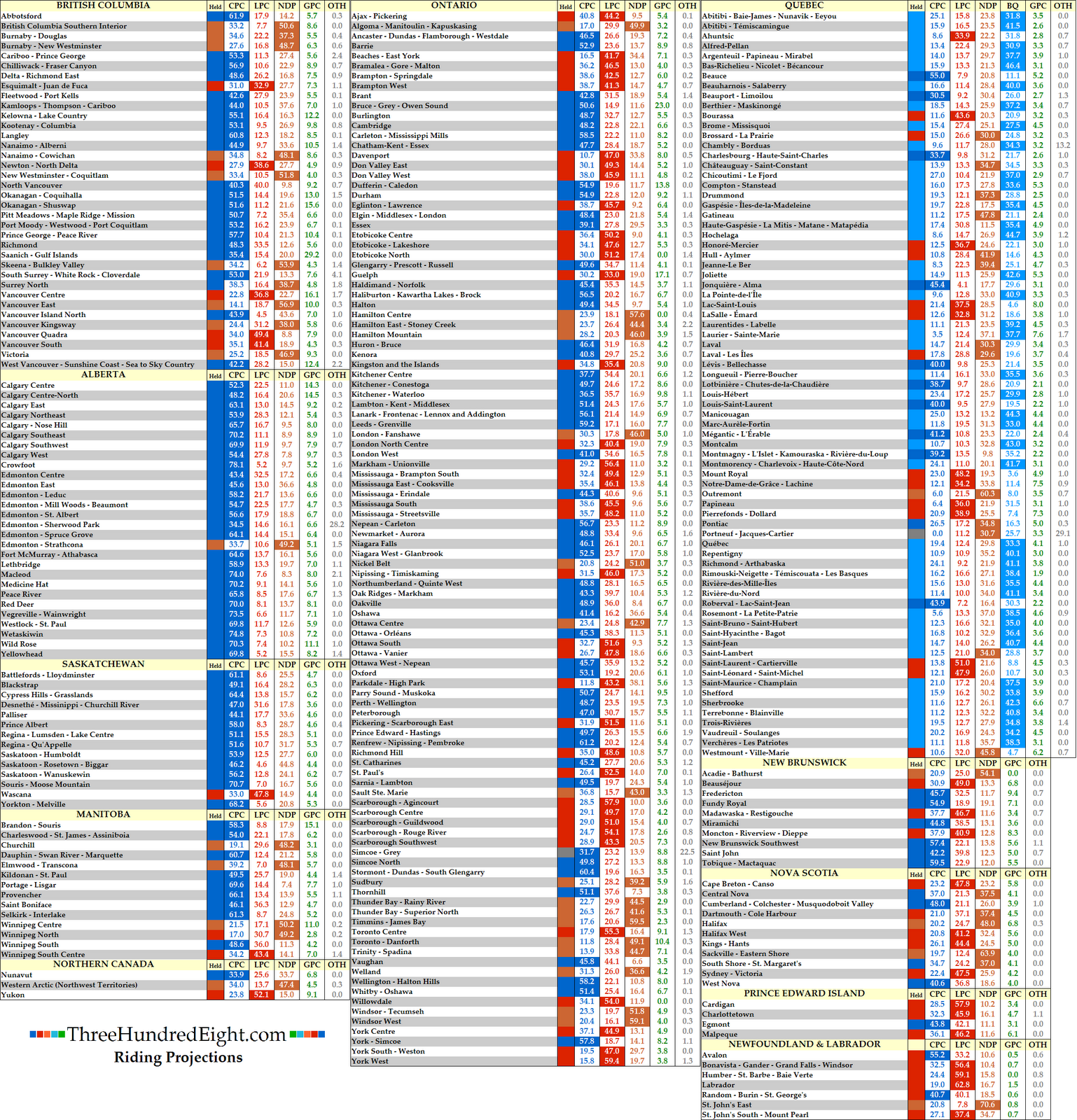
I have not been shy in my fears that Layton's rise could lead to awkward left vote splitting, particularly in a substantial number of seats in Ontario that puts Harper over the top to a majority, but now the NDP has been in the polling lead over the Liberals and Bloc across nearly every region (Three Hundred Eight still shows the Liberals narrowly leading in the Atlantic and Ontario, but the trend in Ontario is clearly in the NDP's favour). What finally starts to reassure me is that the NDP have been projected to win a small number of currently held Conservative seats, and projected to hold a couple that the Conservatives were earlier projected to win.
Voters in Ontario should be most sensitive to the need to vote tactically Liberal, particularly in the 905 belt, plus a few other ridings like York Centre, Kingston and the Islands, London, Guelph and a number of others where the NDP are not very likely to close the gap in time. Sorry NDP, the memory of Premier Bob Rae is still hurting you in the province, fairly or not. I'm not sure why the NDP don't have more traction in the Atlantic, so again tactical voting may apply.
Michael Ignatieff has run on a more liberal platform than I would have expected from him, and in the traditional way campaigns are run and assessed, I think he has done a fair job. His debate performance wasn't terrible, no major gaffes, takes media questions well and he stick handled a few Liberal candidate problems well enough that they didn't become major issues. His personal approval ratings have gone up through the campaign. But he started from such a disadvantage for avoidable reasons such as that he should never have become leader of the Liberal party after the majority of the party's base united behind a dark horse candidate (Dion) to keep him out of that job in 2006. I was one of them. When Ignatieff became leader under strained circumstances in 2009, it's true there wasn't a party revolt, but almost no one was thrilled. Ignatieff started out without the home team cheering section a party leader needs to build a positive image with the population. Harper and Layton both have this. When Harper's inevitable attack ads came screetching in, Ignatieff did not have people to stick up for him in coffee shops and by office water coolers.
Further, much like Hillary Clinton, Ignatieff cannot escape the serious baggage that is his support for the invasion of Iraq while still in America. Both Paul Martin and Stephane Dion were able to make up some ground in 2004, 2006 and 2008 by pointing out Harper's support for that war, while reminding voters it was a Liberal government that kept Canada out of it, and in fact even denied George W. Bush Canada's moral support for the endeavour. It should be remembered as a particularly high point in the Liberal party's history. Ignatieff cannot use this. Meanwhile, Layton and Duceppe can and have used it against him. I'm not opposed to Ignatieff as Liberal leader because he's an intellectual, I'm opposed to him because he's a crappy intellectual who gets important things very wrong. Additionally between Ignatieff and Rae they have denied the Liberals any distinction with the conservatives over Afghanistan and again it is no surprise that the Liberals are bleeding support in a country that is tired of this war. Quebec particularly so and look where the NDP wave started.
Finally there is Jack Layton himself. I have my qualms about him. I never warmed to his personna the way others seem to have, but that alone cannot really be decisive. Layton strikes me a bit like a used car salesman. That perception may be unfair, but it is what it is. That said, I did enjoy Ian Welsh's story about Layton and am willing to revise my views on Layton as events dictate. I don't think he is above cynically exploiting issues for partisan advantage, and I worry that he wants to beat the Liberals much more than he wants to beat the Conservatives. Maybe that's how it has to be for a smaller party hoping to overtake a traditional big-tent party's place. It doesn't happen very often so there aren't a lot of models to compare against. For NDP supporters I hope they can keep a small part of their brains aware that Layton is a politician and a human and he is not immune to the failings of those classes. Layton can and has put the Party's interests over the interests of Canada. He does it less often than the Liberals, but it does happen. I worry about Layton's ability to hold to the NDP's progressive core while trying to navigate a massively enlarged coalition. He has not persuaded me that his promises to Quebec come from sincere progressive convictions about how Canada should accomodate our two solitudes, so I sense opportunism. I am giving Layton a chance to prove my fears wrong. Nothing in his record is as odious as Ignatieff's writings on torture or in support of a pointless, illegal and unjustified war against Iraq. Certainly he will be a better Prime Minister than Harper because he doesn't believe in all the bad ideas Harper does. Conservatism doesn't work, and remains a destructive force of inequity, dishonesty and division upon the modern world. The differences between Layton and Ignatieff are important, but next to Harper both are vastly preferable for the simple reason that they are at least open to doing the right things for Canada.
At the start of this election, my read was that the best that could come out of it would be another Tory minority which led to changes of leadership potentially in all four parties. Now at least Layton's rise has given me something more to hope for. We might actually be able to get Harper out of 24 Sussex and the NDP might get a chance to show Canadians how well progressive government can work for them, and for Canada. There's a lot of obstacles still even if Layton does become Official Opposition leader, but something has finally changed from our 5 years of political stalemate. The overwhelming need is to remove Richard Nixon North from office and I'm prepared to support the best available option to do so. The NDP are now that best option for most places in the country and deserve a chance to prove the skeptics wrong.
Showing posts with label Michael Ignatieff. Show all posts
Showing posts with label Michael Ignatieff. Show all posts
Saturday, April 30, 2011


Wednesday, April 27, 2011
Prediction is Difficult, Especially About the Future
With apologies to Niels Bohr, I just wanted to take a moment and point out that the art or science of predicting Canadian election outcomes is actually far less advanced and accurate than American readers might be used to. I have written of my fear that the NDP boom could lead to the obscene outcome of a Conservative majority on a scant 37-38% of the national popular vote, but I could easily be quite wrong, and I really hope I am.
Partly that is because the situation is still developing and if the NDP "orange crush" continues to grow until election day itself, then it will quite likely go past the second tipping point I discussed, where the NDP actually wins significant numbers of currently Liberal, BQ and (most importantly) Conservative seats where they up until now are not believed to lead, rather than just splitting the non-conservative vote and letting the Conservatives win a number of normally Liberal or BQ ridings without increasing their actual support.
The problem for the NDP is that they started so far behind the Liberals and Conservatives that even a historic 5-10% increase in national support doesn't necessarily make them competitive in nearly enough ridings to guarantee a Tory minority. I don't rule out the possibility of a super-duper history changing increase in support of 15% or more that actually puts the NDP into real competition with the Conservatives to form the government. After all, this actually happened in Ontario in 1990, which shocked the nation (and the NDP) by delivering an NDP majority government to Canada's most populous province.
But putting aside the dynamic nature of the situation very much still in motion, just in general Canadian elections are harder to predict so you should discount significantly anyone's predictions (including mine):
Still, I can't fault the NDP die hards for their enthusiasm. I know they've been hoping for (and, ahem, repeatedly predicting) a break through like this for a very long time. My negativity is just my read on the likely outcome, not some cynical attempt to deflate them. I was against Ignatieff becoming Liberal leader and now he might well preside over the death of the Liberal party as the governing alternative or maybe even as a party at all. Given the choice between another Harper term and some kind of Layton/Ignatieff coalition I will of course hope that Layton can complete this budding miracle. Eric at 308 is skeptical that the NDP can go from fourth to government and offers some solid reasoning why, and I find that more intellectually persuasive than anything I am hearing from the hopeful Orange crowd. But there is a very real chance we're just off the map as far as empirical based models go, and into a realm where polling and past experience offer very little predictive value.
That said, I'm very glad for our non-partisan and rock solid voting system. Because the realm of possible outcomes is quite wide so it's nice to know in advance I can have strong confidence that whatever result we get is real. If it is Jack, I will eat my orange crow with some gusto.
Partly that is because the situation is still developing and if the NDP "orange crush" continues to grow until election day itself, then it will quite likely go past the second tipping point I discussed, where the NDP actually wins significant numbers of currently Liberal, BQ and (most importantly) Conservative seats where they up until now are not believed to lead, rather than just splitting the non-conservative vote and letting the Conservatives win a number of normally Liberal or BQ ridings without increasing their actual support.
The problem for the NDP is that they started so far behind the Liberals and Conservatives that even a historic 5-10% increase in national support doesn't necessarily make them competitive in nearly enough ridings to guarantee a Tory minority. I don't rule out the possibility of a super-duper history changing increase in support of 15% or more that actually puts the NDP into real competition with the Conservatives to form the government. After all, this actually happened in Ontario in 1990, which shocked the nation (and the NDP) by delivering an NDP majority government to Canada's most populous province.
But putting aside the dynamic nature of the situation very much still in motion, just in general Canadian elections are harder to predict so you should discount significantly anyone's predictions (including mine):
- 308 elections versus 51. First up, predicting the outcome of a US presidential election is easier because there are a lot less constituent parts that decide the outcome.
- Less polling. There's plenty of national and regional polls, but these are really of rather limited value in predicting the individual riding outcomes which actually determine the real outcome. We're a smaller country, a smaller media market, there's just a lot less overall money flowing in the system to pay for the level of polling we see in the US, and polling a state is just much easier for pollsters than any 1 riding (hard to find 1000 adults willing to pick up the phone living within a much smaller geography).
- More competitive races. The US Presidential is 51 seperate elections, but really only a relative handful of these are truly competitive. I haven't crunched the numbers in any meaningful way, but Canada's riding boundaries are not really gerrymandered. The term doesn't even get used up here. There are certainly safe seats for each party, but compared to the US congress, a far higher proportion of MPs in Parliament actually have to compete for re-election. Aside from the lack of gerrymandering, the stronger party system here means that things like the incumbentcy factor and name recognition matter much less. If your party is out of favour, you're in trouble. In 1993, the ruling Progressive Conservatives lost all but 2 seats.
- More competitive parties. Even at their peak in 2000 under Nader, the US Greens were not even a threat to win a state or take a seat in Congress. Sure there was Perot but in general, it's almost always a 2 candidate race. Canada has five parties that could win seats in Parliament. Plus a couple independents. There are a significant number of competitive 3 way races for ridings, particularly in BC and Quebec, and even a four-way race or two. It's just damn difficult to predict the winner in these ridings and even if you are lucky enough to get a riding poll, it's hard to predict how events will affect the support as the poll ages.
- First past the post. Americans have the same system, but it's worth calling this out to avoid confusion say with proportional representation based European multi-party systems, where a 5% increase in support for some smaller party means they get 5% more seats.
Still, I can't fault the NDP die hards for their enthusiasm. I know they've been hoping for (and, ahem, repeatedly predicting) a break through like this for a very long time. My negativity is just my read on the likely outcome, not some cynical attempt to deflate them. I was against Ignatieff becoming Liberal leader and now he might well preside over the death of the Liberal party as the governing alternative or maybe even as a party at all. Given the choice between another Harper term and some kind of Layton/Ignatieff coalition I will of course hope that Layton can complete this budding miracle. Eric at 308 is skeptical that the NDP can go from fourth to government and offers some solid reasoning why, and I find that more intellectually persuasive than anything I am hearing from the hopeful Orange crowd. But there is a very real chance we're just off the map as far as empirical based models go, and into a realm where polling and past experience offer very little predictive value.
That said, I'm very glad for our non-partisan and rock solid voting system. Because the realm of possible outcomes is quite wide so it's nice to know in advance I can have strong confidence that whatever result we get is real. If it is Jack, I will eat my orange crow with some gusto.
Subscribe to:
Posts (Atom)