Showing posts with label seoul. Show all posts

Monday, October 28, 2013

Dedicating Lanes to Transit Speeds Up Cars & Other Seoul Lessons

In a previous post we looked at Seoul's experience with a free market led surface transit "system."  Seoul has several other important lessons to teach Toronto though.  From that excellent paper I was citing:

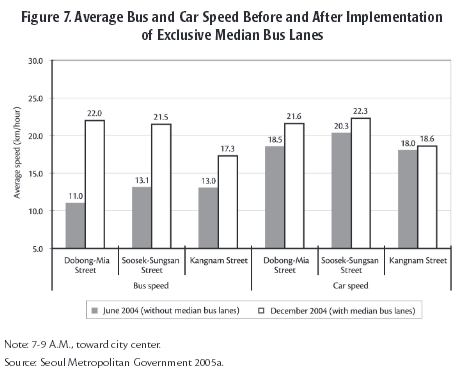
Removing car lanes and dedicating them to transit can speed up everyone's commute:


In Seoul's case this was done with "Bus Rapid Transit" (BRT) where buses operate in dedicated lanes and private traffic is not allowed in those lanes.  But surface LRT on major roads would achieve a similar effect since it would remove the need for buses to operate on those roads (say, Finch Ave W or Sheppard Ave E in Toronto).  Seoul's experience was that bus speeds of course increased tremendously, but so did car speeds:

Private Funding of Transit Infrastructure is No Panacea:


Similar to Mayor Ford's difficulties in finding a for-profit partner to build (or even share costs) on his desired subway expansions, Seoul has found this difficult too.  The above is about LRTs, but even in subways bringing in PPPs is risky, as Seoul has discovered with the privatized "Line 9" subway, constructed in a PPP and where government is required to guarantee revenue to the privatized operators if ridership doesn't meet projections:
if ridership is lower than predicted, the city has had to pay the company tens of millions of dollars each year. MKIF and other investors made 13.1 billion won (US$11.8 million) from the line in 2010, 29.2 billion won (US$26.2 million) in 2011, and 38.4 billion won (US$34.5 million).
As they say of PPPs, the net result is to privatize the profits and socialize the risks.  The experience has already had Seoul nearly come to just buy out the private entities once over a planned fare increase, and as the previous link shows, they are currently changing the structure of the deal due to sustained pubic dissatisfaction with the arrangement.  These changes are causing one of the partners to pull out, poor dears:
But the biggest change is a deep cut in the rate of return guaranteed to private investors, from its current annual level of just over 13% (8.9% after taxes) all the way down to just under 4%.
If it takes a 13% annual ROI to keep free market players in the transit game, this isn't anything like viable. No way running a subway line should be this profitable - it's literally a utility.

World Class Cities Do So Use LRTs In The City:

One of the absurd arguments from subway advocates, led by Deputy Mayor Norm Kelly was that "world class" cities don't put LRT in the city proper, they use it in the outer suburbs, which for Kelly & co means the 905 belt, deeming everything in Toronto's legal boundaries to be "urban" regardless of actual density or zoning.  As noted in a previous post, parts of Scarborough and Etobicoke have lower density than Mississauga or even Brampton, but apparently anything less than subways is a grave insult to these "urban" areas of large single family houses on wide lots with plenty of parkland.  Despite the above mentioned problems getting private partners for all of them, they're pushing ahead on a set of up to 10 lines, from here:


That is a map of Seoul the city, proper.  These are not in their equivalent of a 905 belt surrounding the city.

In fact, Seoul's has one LRT line running already, this one is admittedly outside the city proper, but it was built to serve 32 million riders a year at opening, rising to over 50 million/year in years to come, quite comparable to the projected ridership on the planned Scarborough subway extension.

Sunday, October 27, 2013

What a Free Market Municipal Transit "System" Looks Like

Former Rob Ford chief of Staff Mark Towhey gained some notoriety in the 2010 mayor's race for a blog post he wrote prior to joining Ford's team where he advocated the city simply shut down the TTC and sell off whatever assets that anyone wants to buy.  For anyone familiar with internet libertarians, it is a familiar refrain of blind ideological faith in the free market to provide for all needs, and that government cannot do so.

Sometimes libertarians are operating in the realm of sheer fantasy with no actual real-world examples of the magical benefits they claim will happen out of their various privatization schemes, but in this case there is a contemporary example of a major city that largely left the free market to determine its surface local transit, Seoul, South Korea prior to 2004:


The likely libertarian excuse for all this will be the government controlling the fares and providing operating subsidies - of course the fact that the government found it necessary to control the fares to keep transit affordable to the people most in need of it, the working class & poor won't register with them.  Instead the price controls & subsidies will be some do-gooder activist government intervening apropo of nothing, lacking adequate faith that eventually the free market will cure all its own self created ills.

Nonetheless, even if we accept that fare controls & subsidies have some negative effects, the multiplicity of coordination problems and unethical competitive behaviour are inescapably the consequences of running transit as a for-profit business.  Each transit company still competes for passengers and has incentive to overcrowd, rush & avoid unprofitable passengers. 

All of this goes into why in 2004 Seoul found it necessary to greatly extend the level of government control over the surface transit system, taking control over schedules & routes in addition to fares (while leaving the private companies to still operate the system).

Some context about Seoul is important here - today it is a (groaning as I type this overused moniker) "World Class City" and biggest city in a prosperous rich-world democracy, but that is quite a recent development.  South Korea's income per capita rose tremendously in recent decades so the fact that its bus system was very nearly fully private is an artifact of a developing world governance structure & capability, it also takes place in the context of a society that mostly couldn't afford cars, and thus most people had no other options than transit, however unsafe & inefficient it was.  Once prosperity rose to the level of mass car attainability, use of this wild west bus system fell precipitiously (ibid):

The alternative is to realize that transit is a natural government function as roads & rails are natural monopolies - there's only so much land to build them on, and use is rivalrous, so each competitor on the network makes the network worse.  Government must govern these things if they are to work for the people who need them (rather than for shareholders).  The actual drivers & operators may not need be government employees but the system as a whole needs to be, well, centrally planned or it will be a disaster.  Public transit is a utility, a necessary and proper function of government.
 
This is really quite common for libertarian fantasies - you usually find that their fantasy system used to exist in the early stages of societal development and the government intrusive/managed systems were introduced to solve the obvious, real and pervasive problems that leaving whatever function to the free market created.  Liberal do-gooders and socialists don't win these arguments to have government intervene unless there are already big problems with the status quo.  That government runs transit in most places is no different from why every rich world society found it necessary to have government manage health care, the US being just the latest (and very late) example:  If you want these things to work, government must be involved. 

As usual libertarians, it has been tried your way, and it failed, which is why the government is in there to begin with.  

Incidentally the article I'm quoting is an excellent look at Seoul's stupendous transit system, and more importantly how it got that way, as opposed to "transit porn" pictures of the subway route maps without any context of how it was all funded and built.